Divine Self-knowledge
God is absolutely simple (re: “Classical Theism”); so, for Him to know His Substance cannot involve many different graspings of properties of it. In knowing His Substance, He would only know one faculty which is identical to it (which is subsistent existence itself). However, there are one virtual distinction which exists in knowing an absolutely unified faculty: whatever that faculty is (e.g., the faculty of mind is the power to think) and that it is one. Therefore, God’s exhaustive self-knowledge of His Substance is the virtual distinction between His Substance as the faculty and that it is absolutely simple; and nothing more could God know about His Substance because there is nothing else that He has in it.
It is worth noting an objection: wouldn’t omniscience also require each suppositum to know each other and not just the Substance? Likewise, if not, wouldn’t the Persons not know each other?
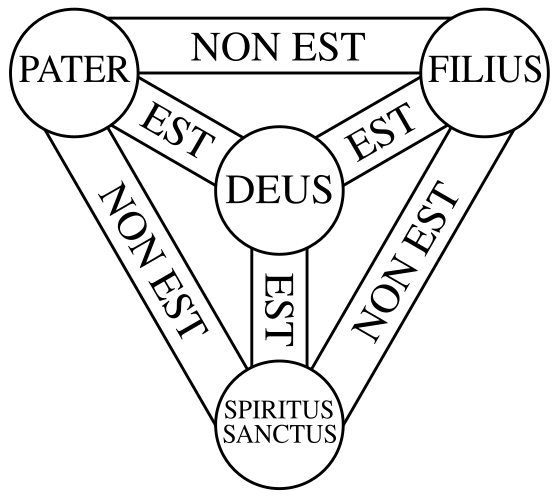
As seen in “The Trinity”, each Person is the completion of that same concrete Substance: they are not personalities, modes of a person, etc. This means that each Person knows each other through knowing the same Substance and through the relations they have to each other. His knowledge of Himself as a Substance, which He must initially know to be omniscient, does not exhaust His self-knowledge: however, the self-knowledge of the Persons is just by way of relations which arise out of that self-knowing essent as opposed to it being there in the Substance itself. E.g., the Father knows the Son by way of knowing His own Substance and the relation which He is exposed to the Son as a Person is that He causes the Son to exist as a suppositum of His own Substance by way of Himself being His own object of thought.
This exposes an even more interesting aspect of the Trinity: since they are relations between the Substance, the Trinity cannot be an aspect of God’s essence. If it were, then two issues arise. Firstly, the Persons would have to encompass each other in their own completions in order to have the full essence (which is impossible). Secondly, the processions in the Trinity start with the Father as the principle cause; which means the Father is ontologically prior to (but not temporally pre-existent to) the Son and, subsequently, the Son with the Holy Spirit. This ontological dependency is an atemporal causing of the two Persons from the one (namely, the Holy Spirit from the Father [and Son] and the Son from the Father). This means that ontologically what “initially” exists in God is just the Divine Substance possessed by the first Person (viz., the Father). This “initial” suppositum—the Father—is complete in Substance, which means He is complete in Essence ontologically prior to the processions to the Trinity. Whatever the Essence is that He has, He must necessitate that procession atemporally from that complete essence in esse. Thusly, the Trinity is not essential to what it is to be God (despite it necessitating from it).