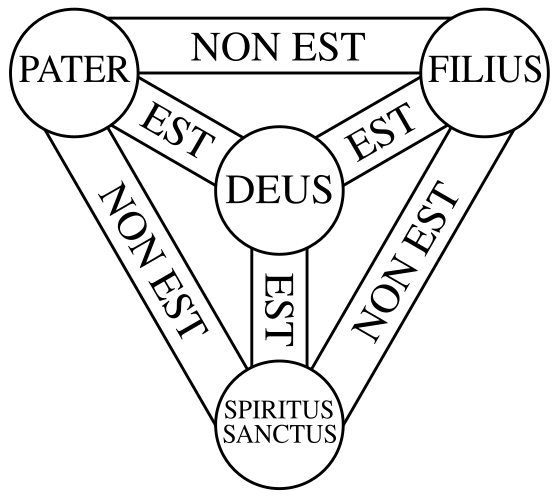
The Trinity
The Trinity is three ‘whos’ in one ‘what’, but what does that mean?
A Basic Understanding
A ‘who’ is a person; and a ‘what’ is a substance. The person is the completion of the substance (viz., the suppositum); and the substance is what bears properties. For example, the skin, bones, soul, mind, will, etc. of Socrates is bore by his human male substance; and this is a different instance of the human male substance than Plato’s.
There are many virtual properties which a substance has which are worth mentioning. Firstly, a substance bears a form which provides the entity with its essence. Secondly, it can bear matter: see hylomorphism. Thirdly, it generally bears real properties (e.g., the apple is really smooth). In the case of Socrates, his substance bears his male form which provides him with his human male nature and actualizes the matter into a functioning body. His soul is just his form: that is, his self-actualizing principle which guides the organic processes and of which he is alive. The person is just the completion of Socrates’ concrete substance: which is Socrates himself.
As noted in “Ontological Dividuation”, the principle of dividuation for entities is supposita and existence. The suppositum marks it out as complete instance; and the existence marks it out as distinct from another concrete instance. However, as noted, God’s Substance is unique in that its existence is identical to itself as an essent and thusly is not a principle of dividuation between instances of His Substance. Thusly, the only principle of dividuation is supposita in God; and this cannot itself provide a principle for dividuating concrete instances of the Divine Substance. Therefore, only one instance of the Divine Substance can exist (re: see the previously linked post for more).
The person is a suppositum of a rational substance (e.g., Socrates possesses his human male substance which is of a rational nature); and God’s Divine Substance is of a rational Nature since He is pure act of thought (re: “Classical Theism”). Thusly, when we say God is three Persons in one, we are saying that God has three supposita which possess or complete the same concrete Substance: they are three wholes sharing the same underlying reality which bears God’s essence as subsisting existence itself.
The Father is the principle cause (viz., paternal); the Son is begotten by the Father (viz., filiation); and the Holy Spirit is spirated by the Father and the Son. By ‘and the Son’, we mean not that the Son has a separate will from the Father (which is explained further in the next section) but, rather, that the Son shares completely in the Father’s Substance at the atemporal moment in which the Holy Spirit is caused in the Trinity (which entails the Son equally shares in it).
What it is not
Multiple Faculties
Not only does God not have multiple faculties (despite us referring to Him with many with analogical predication) because He is absolutely simple (re: “Classical Theism”), the Persons cannot have distinct faculties because they share the same concrete Substance and complete it. For example, the Son and Father (in the Trinity) cannot have two separate wills or minds: they are both suppositum which possess and complete the same exact Divine Will and Mind. Otherwise, they do not share the same concrete Substance; and two of the Divine Substance cannot be instantiated.
Parts of Each Other
The Persons are not parts of each other because they are completions of the one Substance. If a person were a part of another person, then they are not a distinct person; and if a person only possesses a portion of the substance then they are not a completion of that substance. Thusly, the Father, Son, and Holy Spirit are not, e.g., 33% each of the Divine Substance.
Likewise, it is always worth mentioning that God has not parts because He is simple (re: “Classical Theism”); and a suppositum cannot be a part because it is identical to the whole (by definition).
Modes of One Person
A mode of a person is a part of a person, which equally implies no distinct persons (but one instead). Thusly, the Father, Holy Spirit, and the Son are not modes of one ‘personality’.
Personalities
A ‘personality’ is not identical to a person: the former refers to specific dispositions of a faculty or faculties (such as the will, cognition, etc.), which are part of the substance which bears it. As noted before, God is one Substance and no other instance can occur; and a Person is the completion of that concrete Substance. Thusly, the three Persons are not distinct in personalities (as that would imply distinct faculties from each other, which we already demonstrated above are impossible).
It is also worth applying this to creatures to precisely demonstrate what a suppositum is: e.g., Socrates is not a person because he has a personality that is unique to him but, rather, because he has a completion of his rational substance. Likewise, he is completely distinct from Plato (as opposed to being something like a Siamese twin) because he does not share in substance and thusly in matter or form.
Proof from Natural Theology
We can deduce the Trinity from Classical Theism:
P1: God is a Substance of a rational Nature.
P2: A person is the completion of a substance of a rational nature.
P3: Therefore God is a Person.
P4: His omniscience implies He must know Himself as real.
P5: Since He is absolutely simple, His power to existentially confer must be identical to His power to think of an object of thought as real (re: “Divine Simplicity, Omniscience, and Pure Act”).
P6: Therefore, His self-knowledge must cause an existential confernment between Himself and Himself.
P7: This relation of Knower and Known is a real relation because it confers existence from Himself to Himself.
P8: This existence causes no change in Himself because He has no passive potency but is really received by Himself through existential absorption (re: “Existential Confernment and Passive Potency”).
P9: Existential absorption can only happen in substance and a suppositum necessarily is ’this’ which is taken as the object of thought as real when conferring existence (re: “Ontological Dividuation”).
P10: Therefore, this real relation between God must cause another suppositum to complete the same concrete Substance.
P11: This second suppositum must be a Person (from P2).
P12: The first Person which is the Knower (Giver) is the one with paternity and the Known (Given) is the one with filiation.
P13: Therefore, we can say the Knower is the Father and the Known is the Son.
P14: This identity relation cannot be a property of the Father or the Son because a suppositum does not bear properties: a substance does.
P15: Therefore, the paternity and filiation previously described are merely identities marked out by relative opposition (like that of the identity of rock to paper in rock-paper-scissors).
P16: He only has two virtual distinctions in His Substance to be known: His one faculty and that it is absolutely one (re: “Divine Self-knowledge”).
P17: By knowing His faculty, He generates the Son (as shown above).
P18: By knowing His oneness, He contemplates the Son as perfect.
P19: Him knowing Himself as perfect is identical to Him willing Himself as perfect (for the same reasons outlined in for P5 in “Divine Simplicity, Omniscience, and Pure Act” but for His willing faculties).
P20: To will Himself as perfect without the possibility of changing Himself is to love Himself perfectly by definition.
P21: To will Himself as perfect is to will the reality of Himself as perfectly unified (re: “The Relation Between Love and Existence”).
P22: His willing of reality of Himself is identical to Him thinking of Himself as real (for the same reasons outlined in for P5 in “Divine Simplicity, Omniscience, and Pure Act” but for His willing faculties).
P23: His thinking of Himself as real causes an existential confernment (for the same reasons as P5-P8).
P24: This existential confernment causes a third Person (for the same reasons as P9-P11).
P25: This existential confernment, though, is from the Father thinking of the Son as perfect; so this is not a new object of thought of Himself in His contemplation.
P26: Therefore, this is a spiration as opposed to a generation.
P27: This spiration is between the Father and Son as self-love, and is identified as the relation between the Father loving the Son and the Son as loved: this Person which arises out of perfect love is the Holy Spirit.
P28: Because the mechanism by which the Persons are caused is by self-knowledge and there is nothing else about the Divine Substance to be known (re: “Divine Self-knowledge”), it follows that only these three Persons exist in God.
Sacred Scriptures
Matthew 28:19 — Father, Son, and Holy Spirit (RSV-CE)
“Go therefore and make disciples of all nations, baptizing them in the name of the Father and of the Son and of the Holy Spirit.”
2 Corinthians 13:14 — A Threefold Blessing (RSV-CE)
“The grace of the Lord Jesus Christ and the love of God and the fellowship of the Holy Spirit be with you all.”
John 1:1 — The Word Is God (RSV-CE)
“In the beginning was the Word, and the Word was with God, and the Word was God.”
John 1:14 — The Word Becomes Flesh (RSV-CE)
“And the Word became flesh and lived among us, and we have seen his glory, the glory as of a father’s only son, full of grace and truth.”
John 10:30 — The Unity of the Father and Son (RSV-CE)
“I and the Father are one.”
John 14:9 — Seeing the Son and Seeing the Father (RSV-CE)
“He who has seen me has seen the Father.”
John 14:16–17 — The Father, Son, and Spirit (RSV-CE)
“And I will pray the Father, and he will give you another Counselor, to be with you for ever, even the Spirit of truth…”
John 14:26 — The Father Sends the Holy Spirit (RSV-CE)
“But the Counselor, the Holy Spirit, whom the Father will send in my name, he will teach you all things, and bring to your remembrance all that I have said to you.”
John 15:26 — Father, Son, and Spirit (RSV-CE)
“But when the Counselor comes, whom I shall send to you from the Father, even the Spirit of truth, who proceeds from the Father, he will bear witness to me.”
Acts 5:3–4 — The Holy Spirit Is God (RSV-CE)
“Why has Satan filled your heart to lie to the Holy Spirit…?” “You have not lied to men but to God.”
Philippians 2:6 — Christ’s Divine Status (RSV-CE)
“Who, though he was in the form of God, did not count equality with God a thing to be grasped.”
Colossians 2:9 — The Fullness of Deity in Christ (RSV-CE)
“For in him the whole fulness of deity dwells bodily.”
Hebrews 1:3 — The Son and the Nature of God (RSV-CE)
“He reflects the glory of God and bears the very stamp of his nature, upholding the universe by his word of power.”
Matthew 28:19 (RSV-CE)
“Go therefore and make disciples of all nations, baptizing them in the name of the Father and of the Son and of the Holy Spirit.”
2 Corinthians 13:14 (RSV-CE)
“The grace of the Lord Jesus Christ and the love of God and the fellowship of the Holy Spirit be with you all.”
Sacred Tradition
First Council of Nicaea (325 AD)
“We believe in one God, the Father almighty, maker of all things visible and invisible; and in one Lord Jesus Christ, the Son of God, begotten from the Father, God from God, Light from Light, true God from true God, begotten, not made, of one substance with the Father…”
Catechism of the Catholic Church (§242)
“Following this apostolic tradition, the Church confessed at the first ecumenical council at Nicaea (325) that the Son is ‘consubstantial’ with the Father, that is, one only God with him.”
First Council of Constantinople (381 AD)
“And in the Holy Spirit, the Lord and giver of life, who proceeds from the Father, who with the Father and the Son is worshiped and glorified, who has spoken through the prophets.”
Catechism of the Catholic Church (§245)
“The apostolic faith concerning the Spirit was confessed by the second ecumenical council at Constantinople (381): ‘We believe in the Holy Spirit, the Lord and giver of life, who proceeds from the Father.’”
St. Ignatius of Antioch (107 AD)
“Jesus Christ, our God, was conceived by Mary according to God’s plan, both from the seed of David and of the Holy Spirit.” (Letter to the Ephesians, 18)
“Be eager, therefore, to be firmly grounded in the commandments of the Lord and the apostles, so that everything you do, in body and soul, may prosper in faith and love, in the Son and in the Father and in the Spirit.” (Letter to the Magnesians, 13)
St. Justin Martyr (155 AD)
“We reasonably worship Him, having learned that He is the Son of the living God Himself, and believing Him to be in the second place, and the prophetic Spirit in the third.” (First Apology, 13)
“There is pronounced over every person who chooses to be born again, and who repents of his sins, the name of God, the Father and Lord of the universe, and of our Savior Jesus Christ, and of the Holy Spirit.” (First Apology, 61)
St. Irenaeus of Lyons (180 AD)
“The Church, though dispersed throughout the whole world, even to the ends of the earth, has received from the apostles and their disciples this faith: in one God, the Father Almighty, who made heaven, and earth, and the seas, and all things that are in them; and in one Christ Jesus, the Son of God, who became incarnate for our salvation; and in the Holy Spirit, who proclaimed through the prophets the dispensations of God.” (Against Heresies, I.10.1)
“Christ Jesus our Lord and God and Savior and King.” (Against Heresies, I.10.1*)
“For that which is begotten of God is God.” (Demonstration of the Apostolic Preaching, 47)
Theophilus of Antioch (180 AD)
“In like manner also the three days which were before the luminaries, are types of the Trinity, of God, and His Word, and His Wisdom.” (To Autolycus, II.15)
Tertullian (200 AD)
“We do indeed believe that there is one only God, but under this dispensation, or economy, that this one only God has also a Son, His Word, who proceeded from Himself… and that He sent from heaven from the Father, according to His own promise, the Holy Spirit.” (Against Praxeas, 2)
He then explicitly describes the three as a Trinity:
“Thus the connection of the Father in the Son, and of the Son in the Paraclete, produces three coherent Persons, who are yet distinct One from Another.” (Against Praxeas, 25)
“All are of One, by unity, that is, of substance; while the mystery of the dispensation is still guarded, which distributes the Unity into a Trinity, placing in their order the three Persons—the Father, the Son, and the Holy Ghost: three, however, not in condition, but in degree; not in substance, but in form; not in power, but in aspect; yet of one substance, and of one condition, and of one power, inasmuch as He is one God.” (Against Praxeas, 2)
A Deeper Understanding
By looking up towards God’s perfection, we can see more readily how each ordering and created nature can resemble Him more or less: understanding the Trinity becomes the culmination of this process. First, we grasp His perfection in absolute and unique unity; and we see how everything resembles this by degree in His creation. We then recognize why self-preservation is a basic good; and the closest a material creature can get to eternity is self-procreation. We then move to the first procession: the supreme goodness of knowing what is perfect, which is the Father causing the Son. We then recognize why even the brutish of criminals enjoys self-knowledge (no matter how tainted); and why the human species naturally is inclined towards the truth. Finally, we see the final beauty of the processions: the caused Person from the perfect love of the Son by the Father. We then realize the highest good: sacrificial love between eternal Persons. We then recognize why even the lowest of criminals organize themselves adhering to basic virtues which promote communal unity (e.g., loyalty to the gang, sacrificing for the group, being stronger as one, etc.); we see why even the most mentally of ill patients seek self-love as their cure; we see why we have natural inclinations towards friendship and family; and we see why the human species is naturally inclined towards communal harmony. Every good we can measure and order is ordered relative to the supreme love of the Father towards the Son (which the Son equally shares in) which causes the Holy Spirit. It is so perfect of love that it causes another Person to exist: nothing higher can be achieved.