Divine Simplicity, Pure Act, and Omniscience
God cannot have parts (re: “Classical Theism”) and thusly is absolutely simple existence subsisting (viz., an essent). Therefore, when speak of Him having a faculty which can gives existence from pure act (whether that be a generation, spiration, or creation) and having a faculty of intellect, we are speaking only analogically: His intellect as a power and His pure act as a power must be from the same power, whatever that one faculty might truly be.
As such, God knowing an entity as real is the mechanism by which existence is conferred which is identical to pure act: the mode of though of ‘reality’ is the only mode in thinking which conjoins the existence of an entity with its essence. E.g., thinking of a possible apple does not think of the apple as having existence: only by thinking of the apple as real does it convey contemplation of an apple with existence. In humans, since our intellect is not identical to ourselves nor identical to pure act, we can think of an object of thought as real without it actually being real; whereas, God’s simplicity requires that it is really one and the same.
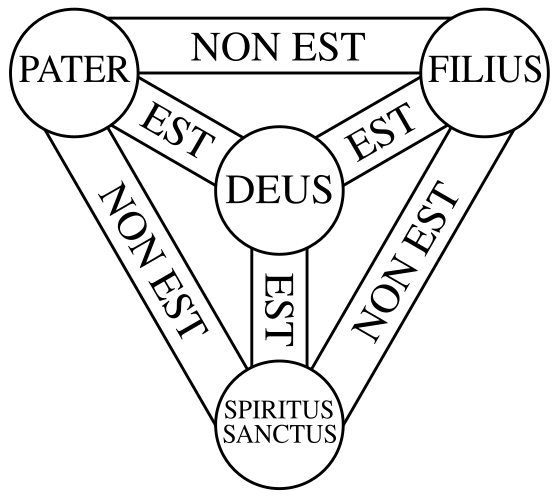
This basic but astounding truth is crucial to understanding how the Trinity can be deduced from God’s Nature (under classical thought): if He must think of Himself as real (in order to be omniscient) and Him thinking of an object of thought as real is identical to His power of pure act, then it necessarily follows that some sort of existential confernment relation happens between Himself and Himself (as subject and object of thought within the modality of what is real). See “the Trinity” for a deeper exposition.