Ontological Dividuation
Ontological dividuation is caused by real distinction in existence or/and suppositum.
For example, Socrates is really distinct from a car. Now, we may initially try to recognize this real distinction by way of a distinction in parts; afterall, Socrates shares no parts with the car. However, there can be two suppositum that share parts (e.g., Siamese twins are two different completions and yet share, e.g., the same legs). On the other hand, we may say it is a separation in substance that distinguishes Socrates and the car; but two suppositum can likewise share a substance (e.g., angels may share the same concrete substance, etc.) and two entities can have the same substance (e.g., two humans in different bodies). Then, we may resort to relations to explain it: by example, two atoms may be identical except for their location in space and yet we would typically still say they are really distinct atoms. However, without derailing too much into the metaphysics of space, it is possible that an atom could be represented in two places at once if the laws (or substance) of space allow it. Likewise, the a priori space which our cognition uses to represent sensations of objects (for us to have a conscious experience) could represent one object as two in space (even if this ultimately is an error in our faculties of representation). Moreover, depending on the rules of what is causing the relation it can clearly allow for the same object to be represented as multiple. For example, my body is represented in time as multiple moments and yet it is of the same real body I have: the ‘me’ from three seconds ago is not really a distinct ‘me’ from now. As seen, the issue is that a relation merely relates two ’things’ together; but that does not inherently require that the two ’things’ aren’t the same ’thing’ in reality. Thusly, relative opposition under laws of relations (such as time or space) cannot itself ontologically dividuate.
Although the distinction in suppositum is the definite factor of dividuation which we may not always know for certain, we can infer ways by which two entities would have to be distinct because it would violate metaphysics. For example, if there is an entity with two forms, then that is really two entities; because a form is the actualizing principle which provides the intelligibility of an entity. So two actualizing principles would necessitate two entities with two substances—not one. Likewise, two entities that share a substance but have two different natures cannot be really two: a substance is the underlying reality instantiated with the form and, as such, is not ontologically separable from the form (and we already demonstrated a form implies a distinct entity). We might, then, want to posit two entities that share two different substances, but they would have to share a suppositum to complete both types of substances to be related; and this would imply that there is one completion—not two.
Some, like Aquinas, may offer us the explanation that matter is the principle of dividuation between the same type of form (and, thusly, the same type of substance). Consequently, it is said that material existents can have more than one of the same type of form (because it is received by different matter); whereas, immaterial existents must be different forms to be distinct (e.g., two angels with the same essence cannot coexist since there is no distinct matter receiving each). The issue is that the substance bears both the matter and form (re: hylomorphism); and, as such, is ontologically prior to the matter and form (even if it is not temporally prior). Therefore, a difference in matter does not automatically constitute a real distinction in substance; and it would be possible for one form being received in two instances of matter within one substance. To admit that matter is a principle of dividuation would require us to make the matter of a material existent as ontologically prior to its substance which makes matter its own substance. By positing it as its own substance, we posit material existents as immaterial existents conjoined to the material substance; which reintroduces the hard problem of interaction in substance dualism: we have eroded the epistemic benefiits of the Aristotelian view of a soul by opting in for to the Cartesian ideology.
Empirically, we know that typically two instances of the same substance exist in separate matter because they clearly have different instances of form (e.g., Plato and Socrates are two different human males). Thusly, there must be something else about material existents which make them really distinct which is not matter, substance, relation, or parts. The real aspects of them which stamps or marks them as unique is their suppositum and existence: it the ontological completion of the substance into an instance of it. The instantiation of a substance is unique and required to have distinct whole: this act of instantiation is already necessary in the process of existential confernment, and positing its ontological uniqueness is thusly parsinomious and coheres well with the concept of instantiation to begin with. The suppositum itself signifies a unique completion; and the real difference in given existence distinguishes the two whole in substance. A difference in existence marks out a distinct substance because the two concrete substances of the same type do have intrinisic existence; so their part of them that is existence itself is uniquely comparable to other existences of substances. However, the existence of a substance does not complete it and thusly cannot solely indicate a new completion: the existence is not identical to the instance but, rather, is the existence that instance has. The instance, or completion, is the total ’this’ that is to be given existence; and, thusly, we can say that suppositum and existence are really as opposed to virtually distinct in them.
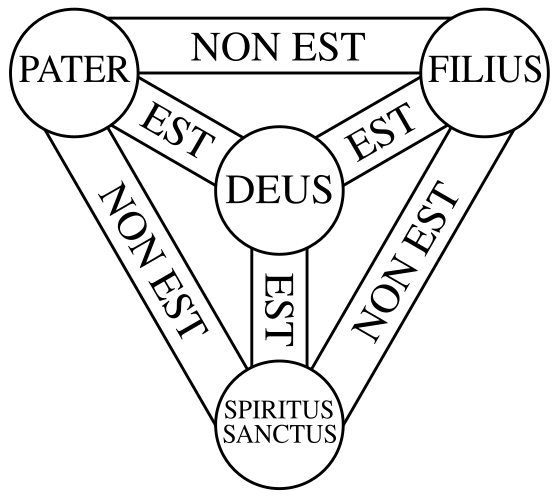
From this, we can note some important things. Firstly, it is entirely possible for there to be immaterial existents with the same essence to exist in different instances of that same type of substance by way of distinct suppositum instantiated with different existence (such as angels belonging to certain species, like Cherubim). Secondly, distinction in form, not in matter, would indicate distinct suppositum: e.g., the distinct self-actualizing principles of the Siamese twins indicates two humans and not one. Thirdly, a suppositum typically indicates a new instance of a substance but does not necessitate it: if the existential confernment were to be towards an already real entity, then the suppositum would be added to the already concrete substance with the previous suppositum (e.g., “The Trinity”, a set of angels which share the same concrete substance, etc.). Since it is impossible to know if God can think of a real entity twice simultaneously, we must admit of the possibility of such configurations of even creatures if God allowed it. This is because the target of the conferred existence is the already real substance; and a whole cannot remain itself as a whole and absorb another whole. Normally, in nature, a whole that absorbs another whole destroys at least one; but in pure act God cannot fail to confer the suppositum in the given instantiation and thusly the supposita conferred to the same concrete substance cannot fail to complete that one substance (despite the substance absorbing the existence).
Fourthly, we can say that God cannot create Himself with a new instance of the Divine Substance: if He were to confer existence to His essence (as opposed to His concrete Substance), it would create a substance which is dependent on Himself for existence which, by definition, cannot be an essent and thusly is not an instance of His Nature. Fifthly and finally, we can say that two or more of the Divine Substance cannot coexist eternally (as uncreated by each other): the unique marker of existence (mentioned before) only exists in existents by way of the pure act which ultimately gives them existence as a part of them, and without that a new suppositum of a substance does not itself divviduate the substances from each other. When we say that this Cherubim is not that one (despite them having the same form which is not received by matter) in substance (and not just as a different completion of that whole), we are able to say this because God’s pure act is distinct for each which gives them distinct conferenment of existences. In other words, both Cherubim have existence as part of them; and this composition between form and existence traces back to a unique pure act which places its mark ontologically on each in existence. This necessitates that the two pure acts which have substantially distinct Cherubim produces two instances of that substance distinct in existence; and each have a distinct completion. The distinct completions make them distinct in identity; and the distinct existences make them distinct in substance. One may object: didn’t we posit the suppositum to differentiate the same instance of a substance in material existents and, if so, then wouldn’t it be simpler to posit this unique existence instead of suppositum and existence? Without the completion, there is no whole; and without existence the suppositum is not. Just as there is a real distinction between the existent’s essence and esse, there is a real distinction between esse (i.e., existence) and supposita. Now, an essent is identical to existence itself: existence, then, is not unique identifier through pure act between two instances. There is nothing at all which divviduates them in Substance; and thusly only one can exist. However, it would be metaphysically possible for multiple supposita of this concrete Substance since they would have existence (from the one existing Substance) and are really distinct wholes.