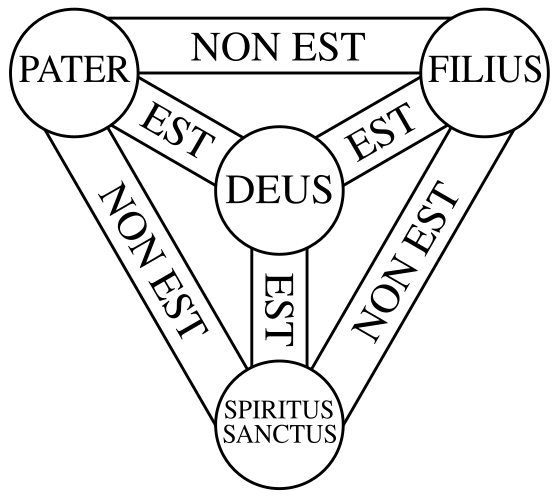
Classical Theism
God is not a highly complex and eternal mind which resides outside of space and time that initiated the Big Bang: He is existence itself as an entity that actively sustains the existence of others—He is an absolutely unique instance of an essent.
The Ipsum Ens Subsistens can be a daunting and perplexing concept to apprehend, but it is the simple truth about God which makes everything else about Him fall into place.
His Existence: A Proof From Composition
P1: A part is ‘that which contributes to the whole but is not identical to it’.
P2: Reality is either an infinite causality of composed entities or it has at least one uncomposed entity.
P3: Reality being only an infinite causality of composed entities would be impossible because they all lack intrinsic existence and yet they exist (just like how an infinite chain of electric ovens cannot themselves explain how one of the ovens has electricity even if electricity is conferred between them infinitely).
P4: There must be at least one uncomposed entity [P1 & P2].
P5: An uncomposed entity would have no parts (by definition).
P6: Two entities with no parts are ontologically indistinguishable (see “Ontological Dividuation”).
P7: Two entities with no parts cannot coexist [P4 & P5].
P8: There must be only one uncomposed entity [P3 & P6].
P9: An uncomposed entity would have to be existence taken as an entity (viz., an essent): otherwise, it has at least two parts—namely, His essence and esse.
P10: Change is the actualization of a potential (e.g., the coffee’s potential to be hot is actualized by heating it up in the microwave).
P11: To have real potential, an entity must have parts which can be affected.
P12: This essent has no parts (because He is uncomposed).
P13: This essent cannot change [P10-12]: He must be immutable, eternal, aspatial, and the ultimate cause of every other being.
P14: Power is the ability to cause change.
P15: Since this essent is the ultimate cause of all other beings and cannot be changed, He must be the only entity with intrinsic power [P14 & P13].
P16: To be omnipotent is to have intrinsic power.
P17: Since an essent has no parts [P5], He has intrinsic power, and to be omnipotent is to have intrinsic power; an essent must be identical to pure power itself (and not merely have it).
P18: Goodness is the equality of a being’s essence and esse: it is unity between intelligibility and existence.
P19: This essent must be identical in essence esse [P9], so He must be perfectly good.
P20: The cause must be in someway in the effect (i.e., principle of proportionate causality).
P21: This essent ultimately causes everything else [P13] but has no parts, so He can only be proportionately in His effects by way of their forms (see “what is proportionate in the effect from this Cause?).
P22: The only kind of entity that can cause intelligibility to be instantiated in existence is a cause that can apprehend essences to create a form and the only kind of being that can apprehend essences is an intellect.
P23: This essent must be an intellect [P21 & P22].
P24: This essent has no parts [P5], so pure act of intellect must be identical to pure act.
P25: An intellect that lacks complete knowledge has the passive potency to learn.
P26: This essent has no passive potency [P11-13], so He must have a fully realized intellect: otherwise, He would have the potential to learn [P25].
P26: To be omniscient is to have complete knowledge.
P27: This essent must be identical to pure and complete knowing (i.e., omniscience).
P28: An intellect always wills what He believes is good.
P29: Everything this essent believes is good must be good (since He has perfect knowledge) .
P30: Everything this essent intellectually wills must always be what is good [P26-28] (see “To Will What is Best”).
P31: To be omnibenevolent is to will what is good always.
P32: Since an essent has no parts [P5], He must be identical to the pure act of willing what is good (i.e., omnibenevolence).
C: This absolutely simple essent must be identical to pure act of intellect, pure act of good will, perfect goodness, pure actuality, pure power, absolutely unique, immutable, eternal, non-corporeal, and the active cause of existence for all existents: this is God.
His Power of Existential Confernment
Since He is absolutely simple and pure act of thought and pure act, it follows that His ability to confer existence must be identical to Him thinking of His object of thought within the modality of reality. His pure act is His ability to confer existence, but that is the same as Him thinking. Now, we either have an emanation in God where Him merely necessarily thinking of every possible object confers existence; or His thinking of them as real does. Thinking of an object as possible or even no real (but hypothetical) would be identical to Him as willing it as possible; which would not will it as real. Thusly, Him thinking of it as real is what wills it as real (which confers existence as pure act).
The only object which He must think of as real that is already real is Himself; and this becomes very important for “the Trinity”.
His Love
At this point, we can deduce God is all-loving in the sense of necessarily willing the good of what He wills as real; exactly because He wills the object of His thought as with existence, which confers that existence to it, in perfect understand of its essence, with no external impediment, and this necessarily realizes and wills what is good for that particular existent relative to their essence (and nature). This act of creation is done without benefit to God (because He is changeless as pure act) and for the sake of the creature insofar as He actively supports their existence through time.
In the Trinity, we see that processions cause a perfect and supreme love of Himself towards Himself which spirates a third Person. This necessitates that the Father, through the Son, causes out of love for the Son; which entails that every creature He creates is done with a selfless and supreme love for His own Nature as perfect. Thusly, He also is Love itself (as opposed to being loving) since this pure act is identical to Himself; and of which causes Him to order every creature’s nature towards His own.
Gradations of Existence
Since absolute self-unity is perfection, God is uniquely the most good and His perfection is unbounded. Each creature’s nature resembles what is perfect more or less; and in this way they have more or less existence relative to how close they are to subsistent existence itself. Thusly, every creature is more or less real; and God is the realest.